



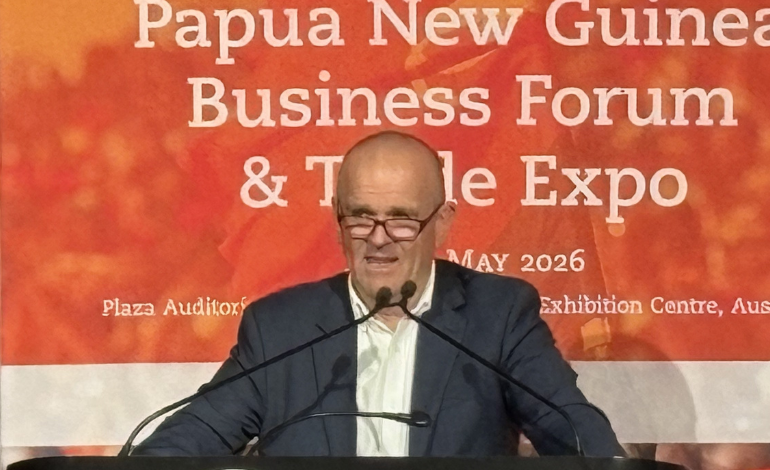
Newly elected President of the Australia Papua New Guinea Business Council, Andrew Cairns, is the Chief Executive Officer of Westpac Bank PNG, where he is responsible for the bank’s strategy, performance, and governance.
He brings extensive experience across banking, telecommunications, manufacturing, engineering, water services, disability services, housing, construction, education, pay television, recruitment, electronic payments, and financial services in the Pacific and Australia, including senior executive and CEO roles, as well as Board-level appointments. He is a Fellow of the Australian Institute of Company Directors and a member of the Papua New Guinea Institute of Directors.
Andrew has a strong track record of leading organisations in complex and developing markets, with a focus on operational excellence, risk management, leading innovation strategies and investment, managing large scale capital projects and sustainable growth.
He has worked closely with regulators, government stakeholders, and Boards on a range of strategic and regulatory priorities and is known for his disciplined approach to execution and accountability.
Since taking on the CEO role in PNG, Andrew has focused on strengthening institutional capability, improving operational performance, and positioning the business for long-term, sustainable growth. He is also passionate about developing local leadership and sees strong, well-governed institutions as critical to PNG’s continued economic progress.
In an email interview with the APNGBC’s Dev Nadkarni, Andrew speaks about the opportunities, the practicalities and encouraging investment beyond traditional sectors, besides his vision for the Council.
What does this appointment mean to you personally?
It’s genuinely a privilege and one I don’t take lightly.
PNG is at an important point in its growth, and the relationship with Australia has a big role to play in what comes next. For me, this role is about helping create something practical. It is about stronger connections, better outcomes for business, and ultimately more opportunity for people in both countries.
What do you see as the biggest opportunities for businesses in both countries over the next five years?
I think we’re moving into a phase where it’s less about single sectors and more about how everything connects.
There’s clear history of opportunity in PNG across the resource, oil & gas and transport sectors but we must not lose sight of the other opportunities in infrastructure, energy, forestry, primary production, education, health and agribusiness. However, what will really unlock growth is better connectivity, especially digital. If we can get that right, it opens the door to new industries and makes it easier for big and small businesses to participate.
At the recent Business Forum, there was considerable discussion about infrastructure, digital connectivity, agriculture and workforce development. Which offers the greatest potential for future growth and investment?
If I had to pick one, I’d say digital.
Not because it stands alone, but because it lifts everything else. It helps more people access vital services, to improve productivity, supports small businesses, and improves how all services are delivered. It’s one of those areas where progress in one place drives improvement everywhere else.
How has your experience shaped your view of PNG?
What stands out to me is the balance between opportunity and complexity.
There’s real potential here in PNG. We have strong fundamentals, a young population, and strategic importance in the region. At the same time, success isn’t always straightforward. Businesses that do well tend to be the ones that take a long-term view, build strong local relationships, and stay patient.
What are your priorities for APNGBC as President, and where would you like to see the Council make the greatest impact?
For me, it’s about keeping things practical. That means:
- Strengthening the dialogue between business and government
- Supporting clearer, more stable policy settings
- Encouraging investment beyond traditional sectors
- And working more closely with BCPNG so we’re aligned
Ultimately, I’d like us to focus on outcomes making it easier to do business and helping unlock real investment.
PNG celebrated 50 years of independence in 2025. Looking ahead to the next 50, what changes would you most like to see?
I’d like to see a more diversified and resilient economy.
That includes stronger private sector growth, better infrastructure, ubiquitous connectivity, world class social services, accelerated productivity and participation improvement, and broader access to financial services and inclusion. If we can keep improving governance and creating a more predictable business environment, PNG has every chance to play an even bigger role in the region. We must continue to be a competitive place to attract capital, be it financial, human, innovation, environmental, productive, or social capital.
How would you encourage businesses to look at opportunities beyond the extractive industries, especially in emerging sectors like agribusiness, financial services, manufacturing and the digital economy?
PNG has more to offer than many people realise—we just need to keep telling that story and backing it up with results.
There are real opportunities in downstream processing, agribusiness, fisheries, sustainable products, education, health, financial services, tourism, and the digital economy – just to name a few. The key is building confidence by showing domestic and international investors that these sectors are viable and making it easier for them to participate alongside local partners.
How would you better align APNGBC and BCPNG?
There’s a real opportunity to be more coordinated.
If we align our positions and speak with a consistent voice, we can be more effective, particularly on the issues that matter most to business. It’s about collaboration, not duplication.
What’s your message to APNGBC members and prospective investors about the future of the Australia-Papua New Guinea business relationship?
PNG is a market that rewards those who take a long-term view.
The fundamentals are strong, but success comes from understanding the environment, building relationships, and staying committed. For those willing to do that, the opportunity is there. It is about getting the geographic, business, community, investment and political enablers moving together and collaboratively.
What would you like APNGBC members to say you achieved during your time in the role?
I’d like to be seen as someone who helped make a practical difference.
If, by the end of my time, we’ve strengthened the relationship, improved the business environment—even in small but meaningful ways—and helped broaden where investment flows, I’d consider that a success.
Main photo: Andrew Cairns speaking at the 41APNGBF. Photo: Dev Nadkarni


