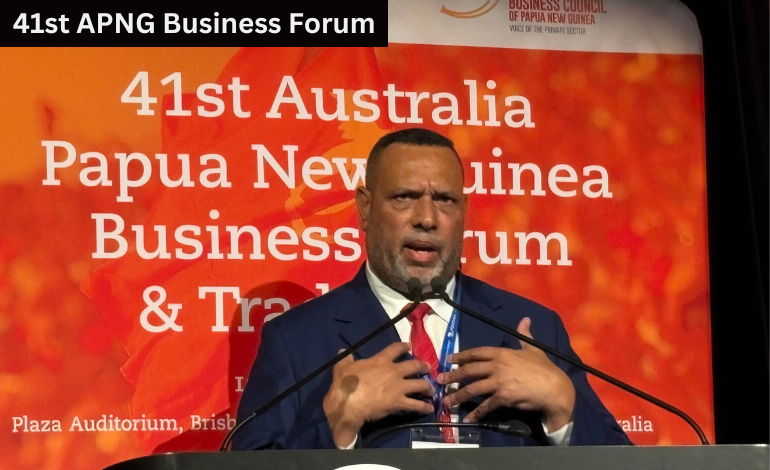
East Sepik Governor Allan Bird used the Henry Kila Memorial Address at the 41st Australia Papua New Guinea Business Forum & Trade Expo to argue that agriculture, rather than the extractive sector, offers Papua New Guinea its strongest pathway to inclusive and sustainable development.
Mr Bird said PNG had long spoken about moving beyond mining, petroleum and other enclave industries, but now needed to turn that rhetoric into practical action. He said agriculture was central to that shift because 80 to 85 per cent of Papua New Guineans still live in rural areas and rely heavily on traditional agriculture and fisheries, while the sector contributes only around 25 to 30 per cent of GDP.
“PNG’s best pathway to sustainable development lies in transforming its agriculture sector,” he said.
Using East Sepik’s cocoa experience as an example, Mr Bird said practical interventions had doubled production in his province and helped expand cocoa growing across 19 provinces. He said the greater Sepik region had shown that smallholder agriculture could increase rural incomes, support families, create local businesses and drive wider regional activity.
He said more than K1 billion had flowed directly to villages in recent years through cocoa-related activity, with Wewak now emerging as PNG’s fourth commercial airport destination after Port Moresby, Lae and Mount Hagen.
Mr Bird said agriculture was not only an economic sector, but “the most important social and economic developmental foundation” for PNG at its current stage of development. Unlike extractive industries, he said, agriculture generated direct income for rural households, strengthened food security and supported small businesses.
He called for better alignment between infrastructure and production, saying roads, ports, storage facilities and shipping links needed to support areas where agricultural expansion was actually taking place. Ports, he said, were especially important because most trade moved by sea.
Mr Bird also urged reforms in land access, investment protection, intellectual property and public-private partnerships to attract capital into agriculture. He said PNG needed to make itself a more attractive investment destination rather than assume investors would come because of its natural wealth.
He pointed to future opportunities in cocoa, sago, cassava, breadfruit, agroforestry and fisheries, saying research, innovation and climate resilience would be critical.
“Agriculture can transform Papua New Guinea,” Mr Bird said. “When rural incomes rise, inclusive development becomes possible.”
Main photo: Dev Nadkarni